
Atlantic Tarpon
Megalops atlanticus also known as Tarpon
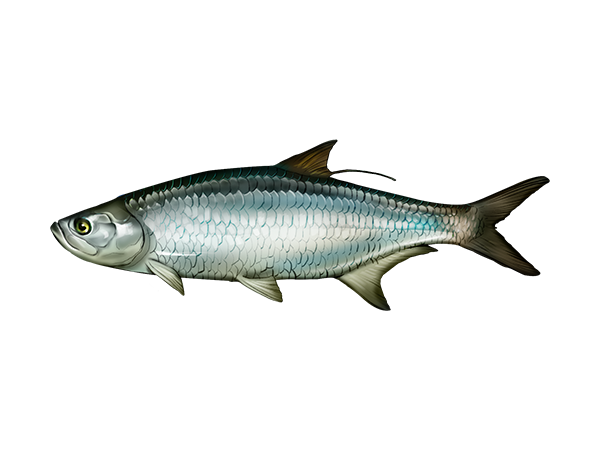
Description
Oceans & Range: Western and Eastern Atlantic Ocean — from Virginia south through Florida, the Gulf of Mexico, and Caribbean to Brazil. Also along the West African coast. In the US, most abundant along Florida's Gulf Coast — the Florida Keys and Southwest Florida are world capitals of Tarpon fishing. Found in coastal bays, river mouths, passes, beaches, and even freshwater rivers.
Preferred Water Temperature: 72°F–90°F. A warm-water species that migrates northward along the Gulf Coast in summer. Roll on the surface to gulp air — an audible, visual cue to locate fish. Concentrate in tidal passes in spring during spawning season.
Size & Weight: Typical fish encountered on Florida's flats run 60–120 lbs. Trophy fish reach 200+ lbs. World record: 286 lbs 9 oz from Lake Maracaibo, Venezuela. The "Silver King" — one of the most spectacular sport fish in the world. Known for explosive jumps that can reach 10 feet. Almost exclusively catch-and-release in Florida — must not be removed from the water without a special permit.
Best Lures: Large swimbaits and paddle tails work around passes. Large soft plastics (Hogy, DOA) are excellent. Topwater lures produce dramatic surface strikes. Fly fishing with large tarpon flies on 12–16 weight rods is the pinnacle of the sport — one of the most challenging and rewarding fishing experiences available.
Best Baits: Live crabs (blue crabs, pass crabs) are the top live bait for migrating Tarpon. Large live mullet work very well. Large live pinfish and threadfin herring produce results. Frozen sardines and mullet work when live bait is unavailable. Always use non-stainless, corrodible circle hooks for easy release.
Habitat
Atlantic Tarpon inhabit a wide range of coastal and nearshore environments, demonstrating remarkable adaptability to varying salinity levels. They are commonly found in shallow bays, estuaries, tidal creeks, mangrove-lined channels, and coastal lagoons where they often roll at the surface to gulp air using a modified swim bladder that functions as a lung. Tarpon frequent passes, inlets, and channels where tidal currents concentrate baitfish. They tolerate brackish and even freshwater conditions, occasionally moving far upriver into freshwater systems. Juveniles typically inhabit protected shallow waters with muddy or sandy bottoms, including coastal marshes and backwater areas with abundant cover. Adults prefer warmer waters above 72°F and are most active in temperatures between 75-88°F, though they can tolerate brief exposure to cooler conditions. They are often found near structure such as bridges, docks, and channel edges, particularly during periods of strong tidal flow when prey is most vulnerable.
Scientific Classification
| Kingdom | Animalia |
|---|---|
| Phylum | Chordata |
| Class | Actinopterygii |
| Order | Elopiformes |
| Family | Megalopidae |
| Genus | Megalops |
| Species | Megalops atlanticus |